On this page
- The map in one paragraph
- The bases compared
- Xiamen: where to land and where to come back to
- Gulangyu: one night on the car-free island (optional)
- The Nanjing side: Taxia, Tianluokeng and Yunshuiyao
- The Yongding side: Hongkeng and Gaobei
- What a night in a tulou is really like
- Tickets
- Quanzhou: the coast after the hills
- Zhangzhou: a quiet in-between stop
- Sample plans without a car
- When to go
- Where to stay: our pages for this trip
Short answer
Use Xiamen as your arrival and departure base, then spend one or two nights in the tulou country rather than doing it as a long day trip. Without a car, the easiest tulou base is the Nanjing (Fujian) side: take the train from Xiamen to Nanjing station, then sleep in Taxia village or right by Tianluokeng. Add Hongkeng in Yongding only if you have a second tulou day and a driver. Finish with a night or two in Quanzhou, a short train ride up the coast.
The Fujian tulou are the round and square earth houses of the Hakka and Minnan clans in the hills of south-west Fujian. They are on the UNESCO World Heritage list, and almost every first-time visitor sees them from Xiamen. The trouble is that "the tulou" are not one place. They are spread over several valleys in two counties, a few hours from the coast, with thin public transport between them. Where you sleep decides how much you see and how much time you spend on buses.
This guide compares the bases, shows how to reach each one by train and bus, and gives a simple plan for three to six nights. If you have not travelled in rural China before, read our guides to getting around China's small towns without Chinese and hotels in China that accept foreigners first. Both matter a lot in the tulou villages.
The map in one paragraph
The World Heritage listing, made in 2008, covers 46 tulou in ten groups. Five of them are in Yongding (now a district of Longyan city): the Chuxi, Hongkeng and Gaobei clusters plus the single buildings Yanxiang Lou and Zhenfu Lou. Four are in Nanjing County (Zhangzhou city; not the big city of Nanjing in Jiangsu): the Tianluokeng and Hekeng clusters plus Huaiyuan Lou and Hegui Lou. The tenth is the Dadi cluster in Hua'an County, also in Zhangzhou. The Nanjing and Yongding groups sit close together (China Discovery puts Nanjing Tulou and Yongding Tulou about 40 minutes apart by car), while Hua'an is off on its own, closer to Xiamen.
From Xiamen, road distances given by the Xiamen local guide Bendibao are roughly:
| Tulou area | County | Road distance from Xiamen | Easiest way in without a car |
|---|---|---|---|
| Dadi (Eryi Lou) | Hua'an | about 115 km | Private transfer; no public transport to the site per the MTR itinerary |
| Yunshuiyao, Huaiyuan Lou, Hegui Lou | Nanjing | about 150 km | Train to Nanjing station, then local bus 6 |
| Tianluokeng, Taxia, Yuchang Lou | Nanjing | about 155 km | Train to Nanjing station, then bus or guesthouse pickup |
| Hekeng | Nanjing | about 155 km | Car from Yunshuiyao (about 10 minutes) |
| Gaobei (Chengqi Lou) | Yongding | about 160 km | Bus from Hongkeng (about 10 minutes) |
| Hongkeng (Zhencheng Lou) | Yongding | about 165 km | Bus to Hukeng from Xiamen or from Longyan |
| Chuxi | Yongding | about 200 km | Car or motorbike taxi from Hongkeng or Xiayang |
- km from Xiamen
Source: Xiamen Bendibao tulou guide (2023), checked 2026-11-12; our table
The chart shows why the Nanjing side is the natural first stop: it is the closest of the big clusters that you can reach by train, and Yongding is only a little further on from there.
The bases compared
| Base | Best for | How you get there without a car | The honest downside | Nights |
|---|---|---|---|---|
| Xiamen (city) | Arrival, departure, Gulangyu, a tulou day tour | Flights, high-speed trains (including from Hong Kong) | A tulou day trip from here is long | 2 |
| Gulangyu (island) | A quiet car-free night in old villas | Ferry from Xiamen | Ferry booking and real-name tickets; carrying bags | 1 (optional) |
| Taxia village (Nanjing) | First night in the tulou country; stream-side village | Train to Nanjing, then bus/park bus or pickup | Park buses are rare on weekdays | 1-2 |
| Tianluokeng (Nanjing) | Seeing the famous cluster lit up at night and early | Train to Nanjing, then about an hour by car | Few places to eat; busy by day | 1 |
| Yunshuiyao (Nanjing) | An old riverside town near Hegui Lou | Train to Nanjing, then bus 6 to the end | Busy with day visitors; less "tulou life" | 1 |
| Hongkeng / Hukeng (Yongding) | Zhencheng Lou, Gaobei and the Yongding clusters | Direct bus to Hukeng from Xiamen, or train to Longyan then bus | Furthest by public transport; one of the busiest clusters | 1 |
| Quanzhou (city) | The old port, temples and lanes | Train from Xiamen, about 30-60 minutes | Not on the way to the tulou | 1-2 |
The rest of this guide goes base by base.
Xiamen: where to land and where to come back to
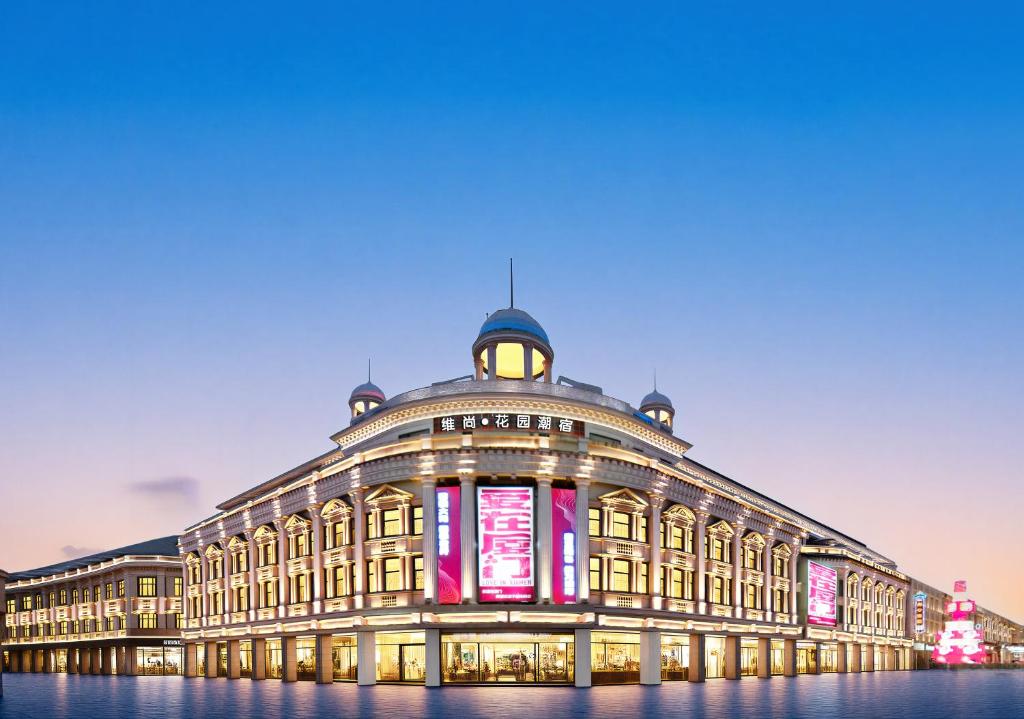
Xiamen is the gateway for almost every tulou trip, and it is a good city to spend two nights in on its own. It has two main stations. Xiamen Railway Station is on Xiamen Island, about 7 km from Nanputuo Temple; Xiamen North is on the mainland in Jimei District, about 23 km away, and handles bullet trains only. Both stations have trains to Nanjing (Fujian), Longyan and Quanzhou, so pick the one closer to your hotel.
Hong Kong travellers can come straight in: TravelChinaGuide's timetable (updated April 2026) lists a handful of direct high-speed trains a day between Hong Kong West Kowloon and Xiamen, taking about 3.5 to 4.5 hours. Xiamen Gaoqi Airport is also a port for China's 240-hour (10-day) visa-free transit. The Fujian provincial government says the policy started there on 17 December 2024 and needs an onward ticket to a third country; check the current rules for your passport before you fly.
Where in Xiamen? For this trip, two areas work best:
- Zhongshan Road and the harbour side if you want to walk out to the old town and take the Gulangyu ferry.
- Around Yundang Lake and the railway station if you want to be close to Xiamen Railway Station for an early train to the tulou.
Our Xiamen page lists hotels in both, plus the Xiamen University and east-coast areas.
Do not carry big bags to the tulou. Leave your main luggage at your Xiamen hotel and take a small bag for one or two nights. Many inns sit inside old buildings or down village lanes, and China Highlights notes that Chuxi has many steps between its tulou.
Gulangyu: one night on the car-free island (optional)
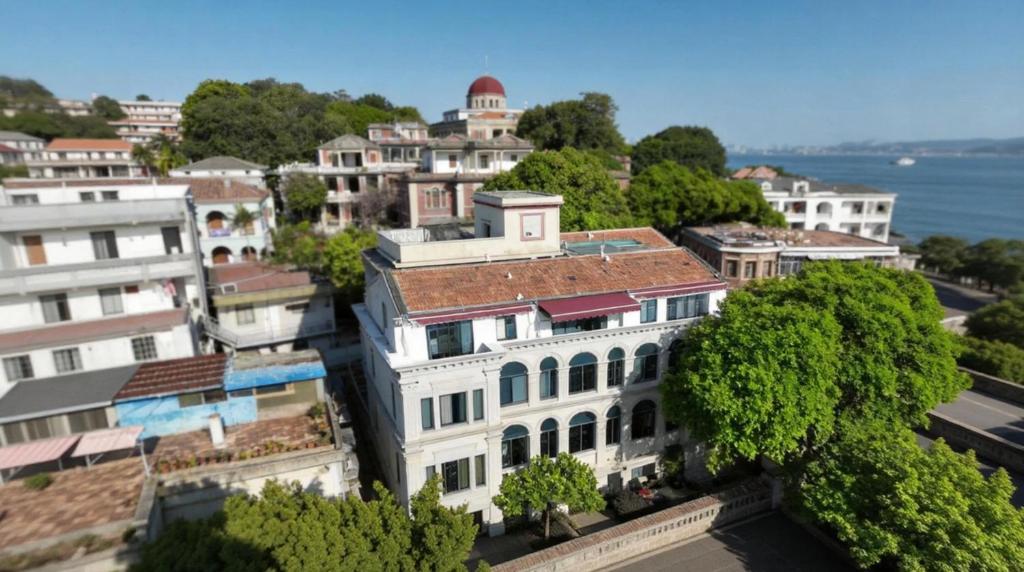
Gulangyu, the small island facing Xiamen's harbour, was added to the World Heritage list in 2017 as "Kulangsu, a Historic International Settlement". After 1902 it was run by a municipal council in which thirteen foreign countries took part. Cars and bicycles are banned; only small electric buggies and service vehicles run on the island.
Day visitors crowd the island, so a night there gives you quiet lanes in the evening and early morning. Things to know:
- Ferries: most daytime visitors leave from the Xiamen International Cruise Terminal (also called Dongdu), according to China Discovery. Night ferries run from Lundu to Sanqiutian pier.
- Real-name tickets: the MTR's own Xiamen itinerary says visitors need a real-name ticket, and that foreign visitors must board from the Xiamen East ferry terminal before 18:30; after 18:30, boarding is from the Xiamen ferry terminal. Book ahead at weekends and in Chinese holidays.
- Luggage: there are no cars to carry bags, so pack light or use a hotel near the pier.
If a night on the island feels like too much hassle, the hotels along Lujiang Road on the Xiamen side look straight across at Gulangyu. Our Gulangyu page covers both.
The Nanjing side: Taxia, Tianluokeng and Yunshuiyao
This is the best tulou base for most people without a car. The reason is the train. High-speed trains run from Xiamen and Xiamen North to Nanjing station: China Discovery lists more than ten a day from Xiamen North, taking 30 to 60 minutes. The travel writers at Museum of Wander, in a guide updated in July 2026, took a train of about 40 minutes and then a car of about an hour to Tianluokeng.
From Nanjing station you have three ways into the hills:
- Local bus. Zhangzhou Bendibao says a minibus runs from the station to Nanjing County Bus Station, where bus 6 leaves for the tulou about every 25 minutes in the daytime. Its far end is Yunshuiyao.
- Tulou shuttle from the station. Xiamen Bendibao describes tourist shuttles from Nanjing station about once an hour, taking roughly 1.5 hours.
- Pickup from your guesthouse. Museum of Wander advises messaging your guesthouse after booking to arrange a station pickup. This is the easiest option.
Inside the scenic area, Zhangzhou Bendibao says a sightseeing shuttle runs from the visitor centre up to Tianluokeng, and in Yunshuiyao a free shuttle with your ticket links the car parks at Huaiyuan Lou and Hegui Lou. Wikivoyage warns that park buses are rare on weekdays outside holidays, so on a quiet Tuesday you may need a taxi or a lift arranged by your inn.
Taxia village
Taxia is a stream-side village of tulou and older houses below the Tianluokeng ridge, about 7 km from Tianluokeng by road and about 3 km from the leaning Yuchang Lou. Wikivoyage calls it a better overnight base than Tianluokeng itself. It has a hostel, guesthouses and rooms in restored tulou, and riverside places to eat. You can walk to Yuchang Lou along the river.
- Good for: a first night, couples, anyone who wants evening walks and breakfast by the stream.
- Watch for: you depend on the park bus, a taxi or your inn's car to reach Tianluokeng.
Tianluokeng
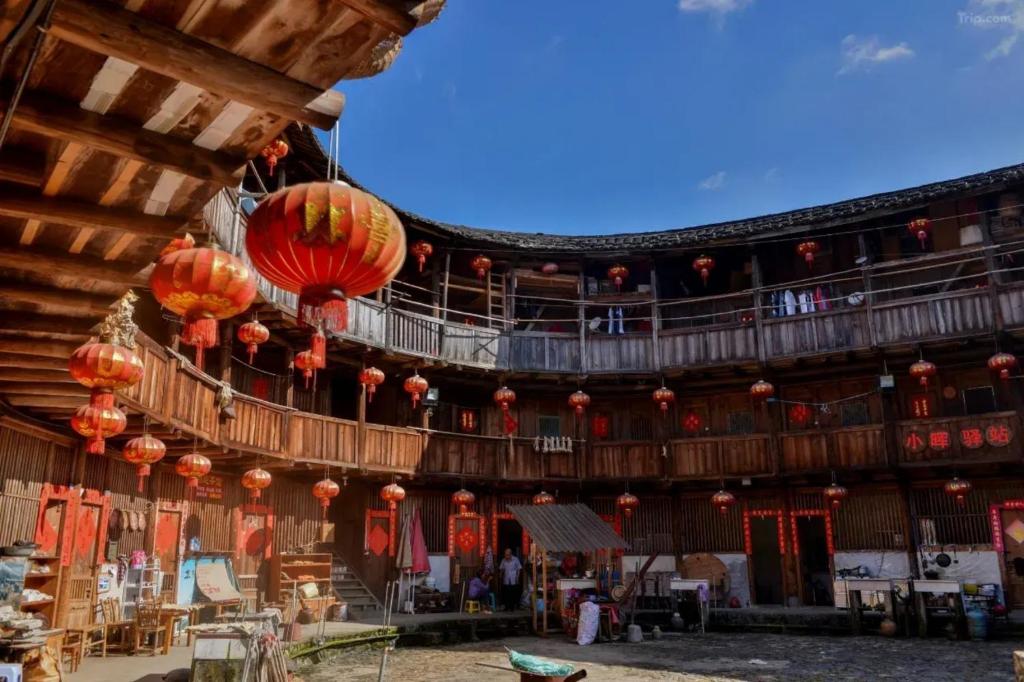
Tianluokeng is the famous "four dishes and a soup": a square tulou ringed by three round ones and one oval one, on a hillside. Sleeping here means you can see the cluster lit up after dark and reach the viewing decks before the day tours. Museum of Wander stayed two nights in a family-run guesthouse inside the village and describes a free viewpoint on the hill behind it for sunset.
- Good for: photographers and anyone who wants the classic view without the crowds.
- Watch for: a small place with few restaurants; quiet once the day buses leave.
Yunshuiyao
Yunshuiyao is a larger settlement with an old town along a river, and it is the base for Hegui Lou (the tallest square tulou, five storeys and 21.5 m high, built on swampy ground) and the double-ring Huaiyuan Lou. China Highlights finds it busy with people taking photos and less about tulou life, but it is the easiest place on the Nanjing side to reach by local bus, since bus 6 ends here. The quieter Hekeng cluster is about 10 minutes away by car.
- Good for: travellers using only public buses; families who want easy riverside walks.
- Watch for: day crowds around the river and the shops.
See our Nanjing Tulou page for Taxia and Tianluokeng stays, and our Yunshuiyao page for the riverside villages.
The Yongding side: Hongkeng and Gaobei
Yongding has the biggest names: Chengqi Lou in Gaobei, built in 1709 and called the "king of tulou", with four rings around a central hall; and Zhencheng Lou in Hongkeng, finished in 1912, nicknamed the "prince of tulou". It is also the harder side to reach without a car.
Getting there without a car:
- Direct coach from Xiamen. China Discovery says coaches leave Xiamen's Fanghu or Xinglin bus stations for Xiayang in Yongding, stopping at Hukeng on the way, and take 3 to 5 hours. Get off at Hukeng for Hongkeng and Gaobei.
- Train to Longyan, then bus. More than 35 high-speed trains a day run from Xiamen to Longyan in under 1.5 hours, per China Discovery. Longyan Railway Station is about 3 km from Longyan Bus Station, where buses to the Hongkeng cluster leave about hourly through the day. Wikivoyage puts the bus at about 2 hours.
- Slow train to Yongding. Only two ordinary trains a day, taking about 3.5 hours; most guides do not recommend it.
Once you are there: Hongkeng is the hub. A local bus to Gaobei takes about 10 minutes, and Hongkeng to Gaobei is only about 4 km. Chuxi, the cluster often called the most beautiful and lived-in, is more than 40 km from Hongkeng, so you need a car or motorbike taxi. China Discovery notes there are no tourist buses between clusters.
Where to sleep: Hongkeng (in Hukeng town) has the most rooms, from simple inns inside old tulou to larger hotels. Gaobei has rooms next to Chengqi Lou. Wikivoyage says rooms inside the touristy tulou are basic, often with shared bathrooms outside, and that many tulou close their gates around 20:00, so buy your entry ticket before you check in.
- Good for: a second tulou day; people who want the most famous buildings.
- Watch for: Hongkeng and Gaobei are among the busiest clusters, with souvenir stalls (China Highlights).
Our Yongding Tulou page lists the Hongkeng, Gaobei and Chuxi areas.
Nanjing to Yongding in one trip
The two sides are close by road but not well linked by bus. China Discovery says there is no direct public transport, though a few Xiamen-to-Yongding coaches stop in Nanjing County and coaches take 40 to 50 minutes between the two. The simplest plan: ask your Taxia or Tianluokeng inn to arrange a driver for a day that covers Hekeng, Yunshuiyao and then drops you in Hongkeng. Museum of Wander hired a driver-guide through their guesthouse for a full day of clusters.
What a night in a tulou is really like
Sleeping inside an earth house is the reason many people stay, but go in with the right picture:
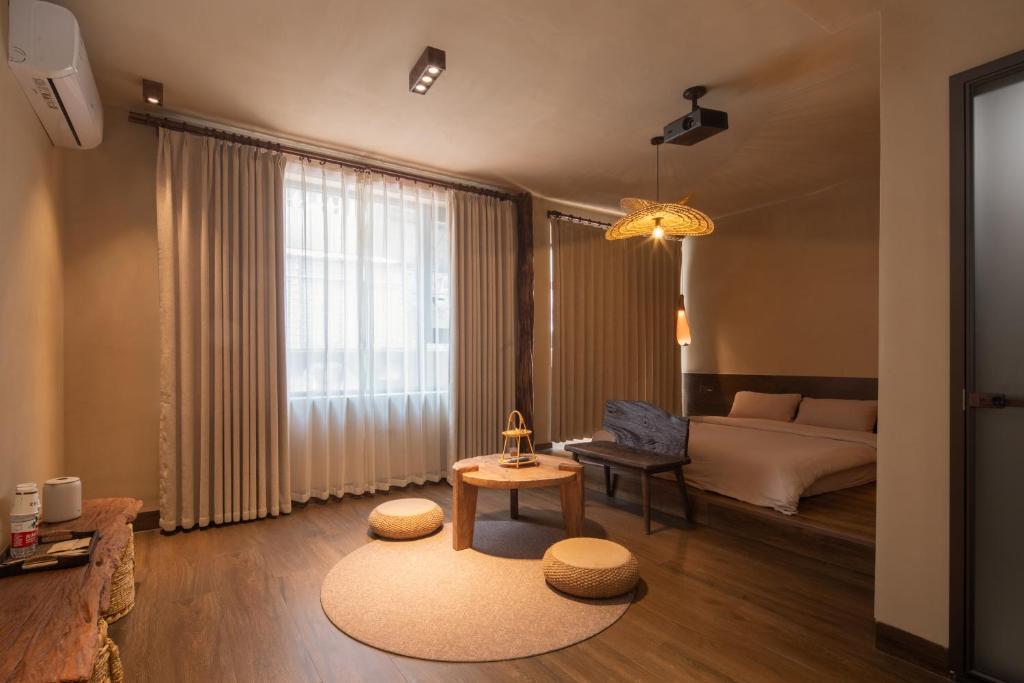
- Bathrooms: Museum of Wander notes most tulou lack modern plumbing, so in rooms inside old buildings you may share a bathroom outside. Some guesthouses built next to the tulou have en-suite rooms; the one Museum of Wander used did.
- Noise: China Highlights warns that converted tulou have poor soundproofing. Wooden galleries carry every footstep.
- Gates: many tulou close around 20:00 (Wikivoyage). Ask your host how to get in late.
- Towels and soap: Wikivoyage says they are often not provided in basic rooms.
- People live here: residents still use these buildings, so keep out of private rooms and ask before taking photos of people.
- Cash: Museum of Wander calls cash "king" in the villages, though Alipay or WeChat Pay can work. Our guide to paying in China as a foreigner explains how to set them up.
Foreign passports. Small inns are the places most likely to say they cannot register foreign guests. Before you book, message the inn to ask if it can take a foreign passport, keep the reply, and keep a cancellable backup in Xiamen or Longyan. Book under the exact name on your passport and try to arrive in daylight.
Tickets
Each cluster has its own ticket. On the Nanjing side, the official scenic area is called Fujian Tulou (Nanjing) Scenic Area, with two sections: Tianluokeng and Yunshuiyao. In Yongding, each area (Hongkeng, Gaobei, Chuxi, Nanxi) sells its own. Fees vary by cluster and change, so check on the day; Zhangzhou Bendibao points visitors to the Nanjing Tulou WeChat account for online booking.
Quanzhou: the coast after the hills
After the tulou, many travellers go back through Xiamen and on to Quanzhou, the old Maritime Silk Road port. In 2021 it was added to the World Heritage list as "Quanzhou: Emporium of the World in Song-Yuan China", a listing of 22 sites that includes Kaiyuan Temple, the Qingjing Mosque and the Luoyang Bridge (China Daily).
Trains between Xiamen and Quanzhou take about 30 to 60 minutes and run often through the day (TravelChinaGuide). The coastal Fuzhou–Xiamen high-speed line, opened in September 2023, also stops at Quanzhou East and Quanzhou South.
Where in Quanzhou? Sleep in the old town around West Street and Kaiyuan Temple. It is walkable, full of food and lively at night, which makes the most of a short stay. The riverside and newer districts suit drivers and business trips more. See our Quanzhou page.
From Quanzhou you can carry on north to Fuzhou, Fujian's capital, on the same coastal line (Wikipedia gives about 55 minutes for the whole Fuzhou–Xiamen run), or to the mountains of Wuyishan in the north of the province. Museum of Wander took a direct train of just over four hours from Wuyishan to Nanjing, so you can also do the trip the other way round: Wuyishan first, then the tulou, then out through Xiamen.
Zhangzhou: a quiet in-between stop
Zhangzhou, the city that Nanjing County and Hua'an belong to, is on the Fuzhou–Xiamen line and has an old town of arcaded streets and stone archways. It is not a must, but it is a calm alternative to Xiamen for one night if you are heading out to Hua'an's Dadi cluster, which has no public transport and needs a transfer.
Sample plans without a car
Three nights (short trip)
- Xiamen: arrive, old town and harbour.
- Morning train to Nanjing, pickup to Taxia or Tianluokeng; evening view of the lit cluster.
- Morning at Tianluokeng and Yuchang Lou; afternoon train back to Xiamen, or on to Quanzhou.
Five nights (both tulou sides)
- Xiamen.
- Train to Nanjing; sleep in Taxia.
- Driver day: Tianluokeng, Hekeng, Yunshuiyao; end in Hongkeng.
- Morning at Zhencheng Lou and Gaobei; bus to Longyan, train to Xiamen; sleep in Xiamen or Gulangyu.
- Train to Quanzhou; old town.
Six nights: add a second Quanzhou night or a day at Gulangyu.
China Discovery suggests one day for the Nanjing clusters and one for Yongding, with three to five days for a combined trip from Xiamen, which matches these plans.
When to go
China Discovery names spring, autumn and early winter as the most popular seasons. Rain data for Xiamen (China Meteorological Administration 1991–2020 normals, via Wikipedia) shows the dry window clearly: October to January are the driest months, and May, June and August are the wettest, with late-summer typhoons adding to the rain.
- Rainfall (mm)
Source: China Meteorological Administration 1991–2020 normals, via Wikipedia (Xiamen), checked 2026-11-12
Avoid Chinese public holidays if you can: China Discovery advises booking Gulangyu ferries about three days ahead for weekends and holidays, and small village inns fill up too. If you can, travel midweek, but remember that park buses on the Nanjing side are thinner on weekdays, so arrange pickups with your inn.
Where to stay: our pages for this trip
- Xiamen: arrival base, old town and station areas.
- Gulangyu: one quiet night on the island, or a view of it from Lujiang Road.
- Nanjing Tulou: Taxia and Tianluokeng.
- Yunshuiyao: riverside villages near Hegui Lou.
- Yongding Tulou: Hongkeng, Gaobei and Chuxi.
- Quanzhou: West Street and Kaiyuan Temple.
- Zhangzhou, Fuzhou and Wuyishan: add-ons.
- Hong Kong: if you arrive by direct train from there.