On this page
- The four areas at a glance
- Why the hills change your choice
- Jiefangbei and Hongya Cave: the first-visit choice
- Western Yuzhong: Lianglukou, Eling and Liziba
- Nanbin Road (Nan'an): the view from across the river
- Guanyinqiao (Jiangbei): food, value and quick getaways
- Getting to your hotel: airport and stations
- How the stations reach the trips around Chongqing
- Where to stay for Wulong
- Where to stay for Dazu
- Where to stay for Jinfo Mountain
- Before or after a Yangtze cruise
- When to go, and why it matters for your room
- Our pick by type of trip
- Where to stay: our place pages
Short answer
On a first visit, stay around Jiefangbei on the Yuzhong peninsula. Hongya Cave, the Yangtze cableway, the night river cruises and the cruise docks at Chaotianmen are all within walking distance. Pick Nanbin Road in Nan'an for skyline views from your window and easy trains to Wulong. Pick Guanyinqiao for food, lower prices and a faster ride to the airport and Chongqing North station. Whatever you choose, sleep close to a metro station, not on a scenic hilltop.
Chongqing is not a flat grid. It is a city of steep hills where two rivers meet, the Yangtze and the Jialing. A street that looks two minutes away on the map can be a long climb up stone stairs. A hotel's front door can be on the 4th floor of a building and its address on the ground. This changes how you should pick a base. This guide compares the four main areas, explains which station and which airport line serve each one, and covers where to sleep for the day trips most people add: Wulong, Dazu, Jinfo Mountain and the Three Gorges cruise.
The four areas at a glance
| Area | Metro | Suits | Watch out for |
|---|---|---|---|
| Jiefangbei and Hongya Cave (Yuzhong) | Lines 1, 2 and 6 meet nearby (Xiaoshizi, Jiaochangkou, Linjiangmen) | First visit, walking to the sights, the Yangtze cruise | Crowds, traffic, street noise on low floors |
| Western Yuzhong: Lianglukou, Eling, Liziba | Lines 1, 2 and 3 | A calmer base on the same peninsula, museums, Liziba | Steep streets; fewer evening crowds and less nightlife |
| Nanbin Road (Nan'an, south bank) | Two lines near the Longmenhao stretch; Danzishi is about 1 km from the metro | River and skyline views, quieter nights, trains to Wulong | Less handy transport, especially at Danzishi |
| Guanyinqiao (Jiangbei, north bank) | Lines 3 and 9 | Food, lower-priced rooms, airport and Chongqing North | Most big sights are a metro ride away; noisy at night |
Sources for the table: China Highlights, China Discovery, Wikipedia station pages, Trip.com (all listed at the end). Our Chongqing page lists the hotels in each of these areas.
Why the hills change your choice
Three things catch out first-time visitors.
Distance on the map means little. A first-timer's guide to Chongqing warns that two points close on a map can be separated by hundreds of steps, and that walking directions can mislead. It suggests walking only short, obvious routes and using DiDi for hills, the last stretch to the hotel, and late nights. Baba Goes China puts it more sharply: choose the wrong spot and you may drag your suitcase up endless flights of stairs.
Entrances sit on different levels. Roads in Chongqing are stacked, so the ground floor on one street can be a high floor on the next. Check which entrance your hotel uses before you set off. One example: the hotel in Tower 1 of Chongqing IFS tells guests that taxis and ride-hailing cars drop off at its 4th-floor entrance, with a second entrance from the mall's B2 level.
A view can cost you time. The same first-timer's guide advises choosing a hotel clearly near a metro station over a scenic hilltop spot. A great view is not worth a long, tiring climb every evening.
Two small habits help. Save your hotel's name and address in Chinese as a screenshot to show drivers. Wikivoyage notes that few taxi drivers speak English. And if you have not booked a hotel in mainland China before, read our guide on hotels in China that accept foreigners first.
Jiefangbei and Hongya Cave: the first-visit choice
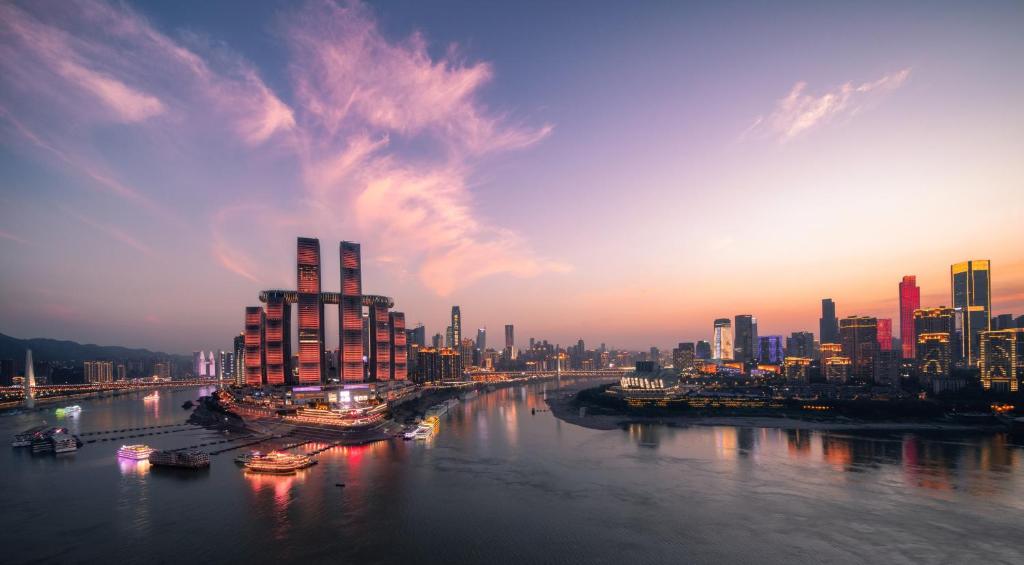
Jiefangbei is the old commercial heart of the Yuzhong peninsula, the tongue of land between the two rivers. China Highlights recommends it for first-timers, for travellers who want the big international hotels, and for anyone boarding a Yangtze cruise, because Chaotianmen Dock is in the same area.
What you can walk to from Jiefangbei Pedestrian Street, according to China Highlights:
- 5 to 8 minutes: Bayi Food Street, the WFC observation deck and Arhat Temple.
- 10 to 15 minutes: Kuixing Tower, the Yangtze River Cableway, Hongya Cave, the Two Rivers night cruises and the Eighteen Steps (Shibati).
- About 20 minutes on foot or 10 by car: Raffles City at Chaotianmen, Shancheng Alley and the Huguang Guild Hall.
Hongya Cave (Hongyadong) is the building most people come to see at night. It is an 11-storey stilt-house complex on the Jialing River bank. Qiansimen Bridge runs past it and joins its top level. China Highlights says the lights come on at about 6 pm in winter, around 6:30 pm in spring and autumn, and 7:30 to 8 pm in summer, and go off at 11 pm. The closest metro is Xiaoshizi (exit 9), about a 10-minute walk. For fewer people, go around 10 pm on a weekday.
Xiaoshizi is an interchange of Lines 1 and 6, and Line 1 ends one stop further on at Chaotianmen (Wikipedia). Line 2, the older monorail, starts at Jiaochangkou in the same district.
The downside: prices run a little higher, and the streets are crowded and jammed with traffic. China Highlights suggests asking for a higher floor, because rooms low down can be noisy.
Western Yuzhong: Lianglukou, Eling and Liziba
The western half of the peninsula is calmer than Jiefangbei but still on the same metro lines. China Discovery points out that Lines 1, 2 and 3 all run through Yuzhong, and that sights such as the Three Gorges Museum, the People's Assembly Hall and Eling Park are close by. Eling Park, one of the city's oldest private gardens, has a tower that looks over both rivers (China Highlights).
This is also where you find Liziba, the station where the Line 2 monorail runs through a block of flats. Wikipedia says the station fills the 6th to 8th floors of a 19-storey residential building and opened in 2005. China Highlights suggests a walk from Liziba to Eling Park by way of the old Eling factory, now a creative park.
Stay here if you want a quieter street at night, are happy to ride a few stops into Jiefangbei, and plan to see the museums. Expect hills: the walk down Eling Main Street to the park is steep.
Nanbin Road (Nan'an): the view from across the river
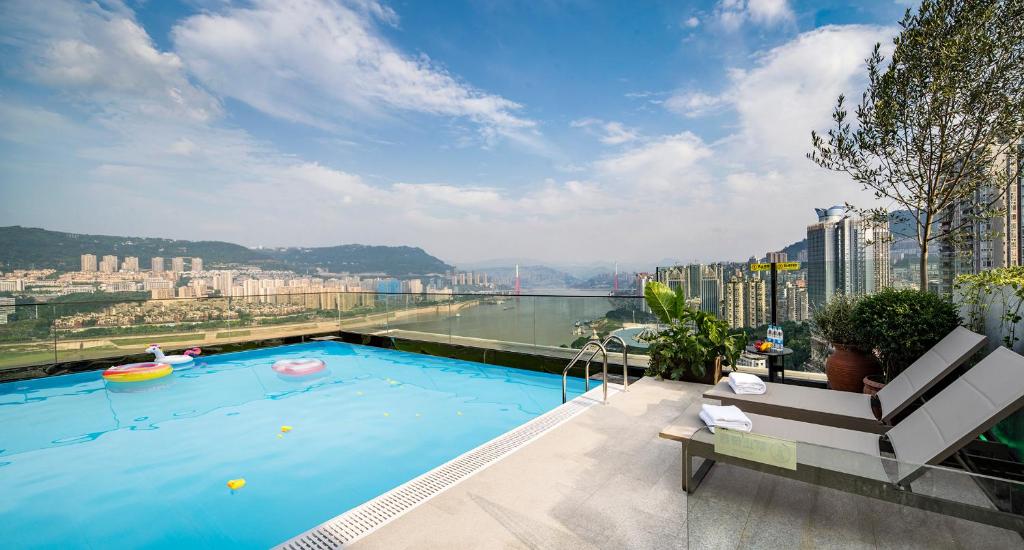
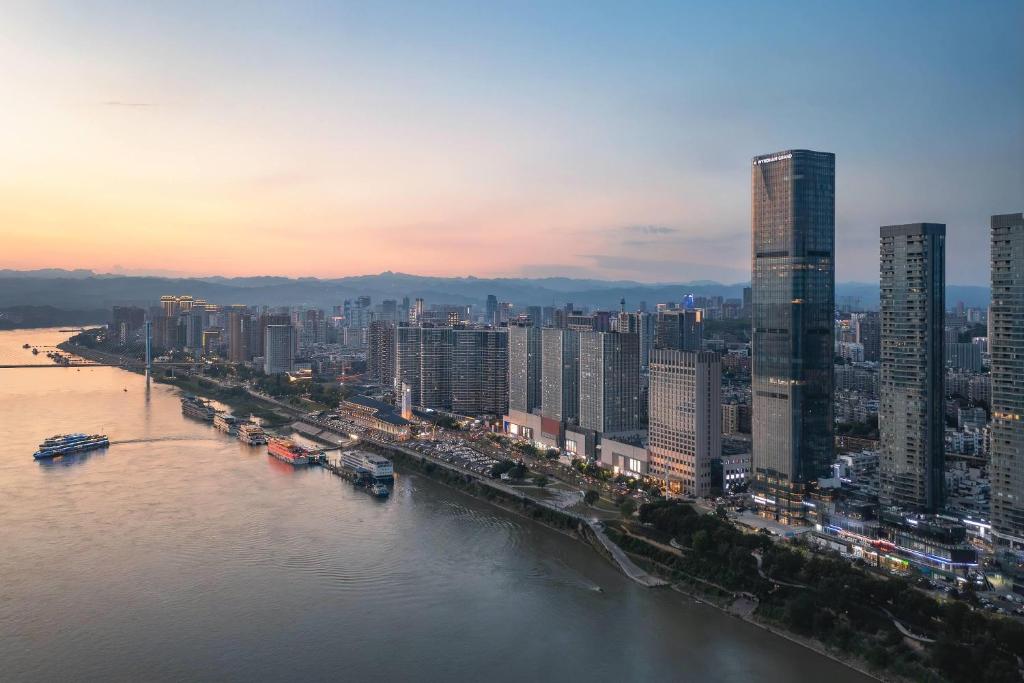
Nan'an is the south bank of the Yangtze. Nanbin Road runs along it, looking straight back at the Jiefangbei skyline. China Highlights recommends it for travellers who want river views, a quieter stay, or who travel with older family members. The trade-off is transport.
China Highlights splits it into two stretches:
- Longmenhao stretch (from Longmenhao Old Street towards the Opening Port Heritage Park): views of the Jiefangbei towers, Dongshuimen Bridge and the Yangtze. Longmenhao, Xiahao Lane and the south station of the Yangtze River Cableway are a 3 to 8-minute walk. Two metro lines are within reach.
- Danzishi: views of Raffles City, the meeting point of the two rivers and the drone show. Hotels here are mostly independent or serviced apartments. The nearest metro station is about 1 km away, so expect to use DiDi.
The Yangtze River Cableway links the two banks. It first opened in 1987 (Wikipedia) and the crossing takes about 5 minutes (Wikivoyage). Its north end is near Xinhua Road in Yuzhong. A night spent in Nan'an and a ride across on the cableway is one of the classic Chongqing evenings.
Evenings on this bank:
- The drone show usually starts around 8 pm on Saturdays and may be called off in rain (China Highlights).
- The Two Rivers Ferry leaves Danzishi Ferry Terminal at 7:30 pm daily on a loop past Chaotianmen Square and the Grand Theatre (Chongqing municipal government's English site, August 2026).
Nan'an has one more advantage in 2026. Chongqing East station opened in Nan'an on 27 June 2025, served by a branch of Line 6 (Wikipedia). It is the start of the new high-speed line to the south-east, which runs through Nanchuan and Wulong. That makes Nan'an a good base if Wulong is on your list.
Guanyinqiao (Jiangbei): food, value and quick getaways
Guanyinqiao is a busy shopping district on the north bank of the Jialing River. China Highlights calls it the city's largest food district, with an indoor food street of about 11,000 square metres and many cheap local eateries. It suits food lovers, younger travellers and anyone on a tighter budget. Most big sights are further away, though Liziba is not far.
Guanyinqiao station is an interchange of Line 3 and Line 9 (Wikipedia). Line 3 runs north to the airport, which is why China Discovery recommends this side of the river for early flights and trains. The downsides China Highlights lists are traffic, noise at night and a hotel mix that is mostly independent rather than chains.
Getting to your hotel: airport and stations
Jiangbei International Airport
The airport is about 21 km north-east of the centre (Wikivoyage). Two metro lines reach it: Line 3 ends at Terminal 2, and Line 10 stops at both Terminal 2 and Terminal 3 (Wikipedia; Wander in China).
- To Jiefangbei: Line 10 to Hongtudi, then Line 6 to Xiaoshizi. Or Line 10 to Zengjiayan, then Line 2 to Linjiangmen. Allow about 50 to 60 minutes door to door, including the change (Wander in China).
- Late arrivals: Wander in China says the last Line 10 train usually leaves the airport around 10:30 to 11 pm. The K01 airport express bus runs until 30 minutes after the last flight and goes to Jiefangbei. DiDi and taxis run all night.
The railway stations
| Station | District | Metro | To Jiefangbei by metro | Main use |
|---|---|---|---|---|
| Chongqing North | Yubei | Lines 3 and 10 | About 25 to 35 min | Chengdu, Dazu, Xi'an, Beijing, Wushan |
| Chongqing West | Shapingba | Line 5 and the Loop Line | About 30 to 40 min | Chengdu, Guiyang, Kunming, Guangzhou, Hong Kong |
| Chongqing East | Nan'an | Line 6 branch | About 25 to 30 min | Wulong South, Nanchuan North, Qianjiang |
| Shapingba | Shapingba | Line 1 | About 15 to 25 min | Some Chengdu and Dazu trains |
Sources: Trip.com station guide, Wikipedia, Wikivoyage, China Discovery, Go Asia (checked 12 November 2026).
Two warnings. First, check the station name on your ticket, because these stations are far apart. Second, the old Chongqing Station at Caiyuanba stopped all train services in June 2022 for rebuilding (Wikivoyage), so do not book a hotel there for the trains.
Which area for which station? Guanyinqiao and the north bank suit Chongqing North and the airport (Line 3). Nan'an suits Chongqing East. Jiefangbei is in the middle and reaches all of them with one change.
How the stations reach the trips around Chongqing
We gathered the fastest train times we could find from Chongqing to the places most visitors add. The numbers come from Trip.com, China Highlights and Go Asia (which quotes the 12306 timetable for 16 October 2026). Times change with each timetable, so check before you book.
- Minutes
Source: Trip.com Chongqing train stations guide; Go Asia Chongqing to Wulong (12306 data, 16 Oct 2026); China Highlights Chengdu–Chongqing trains. Checked 12 Nov 2026.
| Trip | Train | Then | Sleep there? |
|---|---|---|---|
| Dazu rock carvings | 21 to 43 min from Chongqing North, or from Shapingba / Chongqing West | Bus from Dazu South to town, then bus 205 to Baodingshan | Day trip works; one night if you want both main sites slowly |
| Wulong karst | 35 to 57 min from Chongqing East to Wulong South | Bus or taxi to Fairy Mountain town | One or two nights is easier |
| Jinfo Mountain | High-speed to Nanchuan North (Chongqing East line), or coach to Nanchuan | Bus to the North or West Gate | One night in Nanchuan or on the mountain |
| Chengdu | From about 1 hour 3 minutes | Metro | Separate city stay |
| Wushan and the Three Gorges | About 2 hours 12 minutes from Chongqing North | Local bus or taxi into town | Overnight if you add the Lesser Three Gorges |
Where to stay for Wulong
Wulong is a karst area of giant natural bridges, gorges and a high plateau called Fairy Mountain. It is part of the UNESCO World Heritage site "South China Karst", listed in 2007 (UNESCO).
Getting there: Go Asia lists high-speed G trains from Chongqing East to Wulong South in 35 to 57 minutes, and slower ones from Chongqing West, Chongqing North and the airport. Slow K trains go to a different station, Wulong. The two are not the same, so check your ticket. From the station, take a bus or a taxi to the sights.
Where to sleep: China Highlights recommends Fairy Town (Xiannü Town) on Fairy Mountain for first-timers. It has the tourist centre, the shuttle buses, hotels and restaurants in one place. China Highlights suggests one to two days in total: Three Natural Bridges and Longshuixia Gorge on day one, Fairy Mountain and Furong Cave on day two. It warns that doing both the bridges and the gorge in half a day is tiring. Hotels on the mountain itself can have snow views in winter, but dining choices up there are limited.
If you only have one day, sleep in Nan'an the night before, near Chongqing East, and take an early train.
Where to stay for Dazu
Dazu is known for its Buddhist, Taoist and Confucian cliff carvings, made between the 9th and 13th centuries. UNESCO lists five clusters; the two most visited are Baodingshan and Beishan.
Getting there: Trip.com lists Chongqing North to Dazu at about 21 minutes on the fastest train. Wikivoyage counts trains from Shapingba, Chongqing North and Chongqing West to Dazu South, and notes that the station is well outside town. Buses 204 and 206 link it to the town bus stations. From there, bus 205 runs to Baodingshan, about 15 km east, in 30 to 45 minutes. Beishan is only about 2 km north of town.
Day trip or night? With the fast trains, Dazu works as a day trip from any of the four Chongqing areas. Stay a night in town if you want to see Baodingshan and Beishan without rushing. Wikivoyage warns that not every small hotel in Dazu accepts foreign guests, so confirm before you book.
Where to stay for Jinfo Mountain
Jinfo Mountain is a karst table mountain in Nanchuan, added to the same UNESCO "South China Karst" listing in 2014. Travel China Guide says the Azure Stream Valley stays below about 20°C on average even on the hottest days, which makes it a summer escape from the city heat. The ski area at Qianniuping tops out at about 2,080 m.
The new high-speed line from Chongqing East stops at Nanchuan North (Xinhua, June 2025). Travel China Guide also lists coaches from Chongqing to Nanchuan and local buses on to the North and West Gates. Sleep in Nanchuan for transport and food, or on the mountain for the early light.
Before or after a Yangtze cruise
Most Three Gorges cruises start or end at Chaotianmen Dock, at the tip of the Yuzhong peninsula. China Highlights says passengers usually board after 4 pm on day one, and that the downstream trip from Chongqing to Yichang takes 4 days. In the dry season, ships may use Fengdu instead of Chongqing, which adds a transfer of about 2 hours. Check your ship's boarding point a few days before you go.
Where to sleep: China Discovery and China Highlights both point cruise passengers to Jiefangbei, within about 10 minutes by car of the dock. You can drop your bags, walk to Hongya Cave in the afternoon and board without a long transfer. If your cruise ends in Yichang, our page there covers the riverside and the area by Yichang East station. Some cruise routes also stop at Wanzhou and Wushan, both on the river and both with their own pages.
When to go, and why it matters for your room
Chongqing is hot and humid in summer and grey in winter. Wikipedia's climate table for Shapingba (1991–2020) shows average highs near 34°C in July and August, and most rain from May to September.
- Average high (°C)
- Rainfall (mm)
| Average high (°C) | Rainfall (mm) | |
|---|---|---|
| Jan | 10.4 | 20.7 |
| Feb | 13.6 | 22.4 |
| Mar | 18.6 | 55.6 |
| Apr | 23.9 | 103.4 |
| May | 27.4 | 142.5 |
| Jun | 29.8 | 212.1 |
| Jul | 33.7 | 174.2 |
| Aug | 33.9 | 125.7 |
| Sep | 28.5 | 124.7 |
| Oct | 22 | 95.3 |
| Nov | 17.3 | 50.4 |
| Dec | 11.7 | 24.7 |
Source: Wikipedia, Chongqing climate data (Shapingba, 1991–2020 normals). Checked 12 Nov 2026.
What this means for where you stay:
- Summer (June to September): Travel China Guide advises staying indoors in the heat of the day and going out at night. A hotel a few minutes from a metro exit matters more than ever, because long uphill walks in the heat are hard. Jinfo Mountain and Fairy Mountain in Wulong are cooler.
- Autumn and winter: Travel China Guide counts about 104 foggy days a year, mostly in autumn and winter, and says fog often lifts by 9 or 10 am. A river-view room may show mostly mist in the morning; the night view is more reliable.
Our pick by type of trip
| Trip | Stay in | Why |
|---|---|---|
| First visit, 2 to 3 nights | Jiefangbei | Walk to Hongya Cave, cableway, night cruises and food streets |
| Couple who want the view | Nanbin Road, Longmenhao stretch | Skyline from the room, cableway across, quieter nights |
| Food and budget | Guanyinqiao | Huge food district, lower room prices, Line 3 to the airport |
| Museums and a quieter street | Western Yuzhong (Lianglukou, Eling) | Three Gorges Museum, Eling Park, Liziba nearby |
| Cruise the next day | Jiefangbei | Short ride to Chaotianmen Dock |
| Early train to Wulong | Nan'an, near Chongqing East | Direct high-speed trains to Wulong South |
| Early flight or Chengdu train | Guanyinqiao or north bank | Line 3 and Line 10 run north to the airport and Chongqing North |
If Chongqing is part of a longer trip south, our guide to where to stay in Guizhou without a car picks up from Guiyang; China Discovery lists Chongqing West to Guiyang at about 2 to 2.5 hours. For small-town trips with no Chinese, see getting around China's small towns without Chinese.
Where to stay: our place pages
- Chongqing (slug: chongqing): hotels in Jiefangbei, Western Yuzhong, Nanbin Road and Guanyinqiao.
- Wulong (slug: wulong): Fairy Mountain town, villages on the plateau, Wulong town.
- Dazu (slug: dazu): old town, southern new town, Baodingshan.
- Jinfo Mountain (slug: jinfo-mountain): Nanchuan town and Qianniuping.
- Wushan (slug: wushan) and Wanzhou (slug: wanzhou): Yangtze river towns.
- Yichang (slug: yichang): the cruise's other end.
- Chengdu (slug: chengdu): the next stop for many travellers.