About Matera
Matera is not a conventional hill town with one compact centre. Its ancient Sassi are two folds of rock-cut houses separated by the Civita ridge, with a newer, flatter town called the Piano above them.
The Sassi and the Park of the Rupestrian Churches form a UNESCO World Heritage site: houses, churches, cisterns and workshops have been cut into the limestone and rebuilt over many centuries. This is a lived history, not only a scenic backdrop.
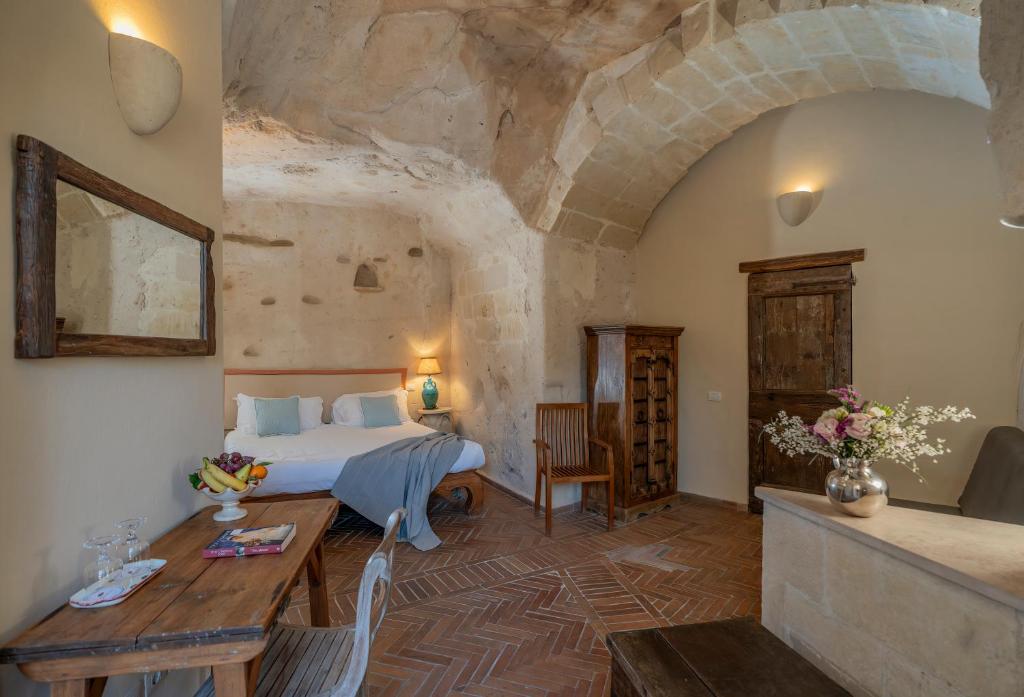
In the 1950s, residents of the cave districts were relocated because of poor living conditions; later restoration brought homes and businesses back. Staying in a cave hotel can be memorable, but you should understand its thick stone walls, uneven floors, stairs and sometimes limited daylight before booking.
Sasso Barisano, on the northwest side, descends from the central square via Via Fiorentini. It has restaurants, small galleries and restored cave rooms, and is a good fit when you want to emerge from your hotel for dinner.
South of the cathedral ridge, Sasso Caveoso is more dramatic, with rock houses facing the Gravina ravine and landmarks such as the church of San Pietro Caveoso and the Casa Grotta di Vico Solitario, where furnished cave rooms illustrate everyday domestic life. Civita rises between the two, crowned by Matera Cathedral.
Sleeping here gives you views over both Sassi but usually means climbing back up from dinner or sightseeing. Above the rock districts, Piazza Vittorio Veneto, Via del Corso and the Piano offer flatter streets, shops and a simpler connection to Matera Centrale station.
This is worth considering if you travel with a pushchair, heavy luggage or mobility constraints, though even there the city has inclines. Ferrovie Appulo Lucane operates regional rail services from Bari via Altamura and publishes separate holiday replacement-bus timetables; check the operating day rather than assuming a normal train runs every day.
Most cave streets are traffic-restricted, so ask the hotel for the authorised drop-off and parking arrangement. For a broader view, Parco della Murgia Materana lies across the Gravina ravine; its viewpoints and rupestrian churches are a separate outdoor excursion, not a balcony reached by walking through the cathedral.
In summer, explore the open stairways early and late because shade is uneven. After rain, polished stone steps can be slippery; in winter, an underground museum or a cave spa can balance shorter daylight. Two nights allow the Sassi to be seen in daylight and illuminated after dinner.
With a third, add the Murgia plateau or a deeper visit to the cave churches rather than rushing between viewpoints.
Common questions
Are Sasso Barisano and Sasso Caveoso the same district?
No. They are separate folds of the old rock-cut town divided by the Civita cathedral ridge. Barisano has more restored commercial lanes; Caveoso retains striking views of cave houses and the ravine.
Can I drive to a cave hotel in the Sassi?
Often not directly. Many streets are subject to restricted traffic rules. Follow the hotel's current instructions for authorised luggage unloading, parking or shuttle service rather than following a car navigation route into the old lanes.
How can I travel from Bari without a car?
Ferrovie Appulo Lucane publishes Bari–Altamura–Matera regional rail and replacement-bus timetables, with variations on holidays. Check the actual date and which Matera station you will use.
Is a cave hotel comfortable in summer and winter?
Many are restored with modern facilities, but they differ considerably. Expect stone walls, unusual layouts and possibly limited natural light. Verify heating, ventilation, stair access and whether spa entry is included.
Where can I get the broad view across Matera?
The Civita ridge and viewpoints around the Sassi offer city panoramas. The Murgia plateau across the Gravina gives a separate perspective over the rock districts and needs its own walking or transport plan.
How long should I stay?
Two nights give time for both Sassi districts, the cathedral and an evening view. Three nights allow a slower visit to rock churches, museums and the Murgia park.
Prices are set by the booking site. We may earn a small fee, at no cost to you.