About Marvão
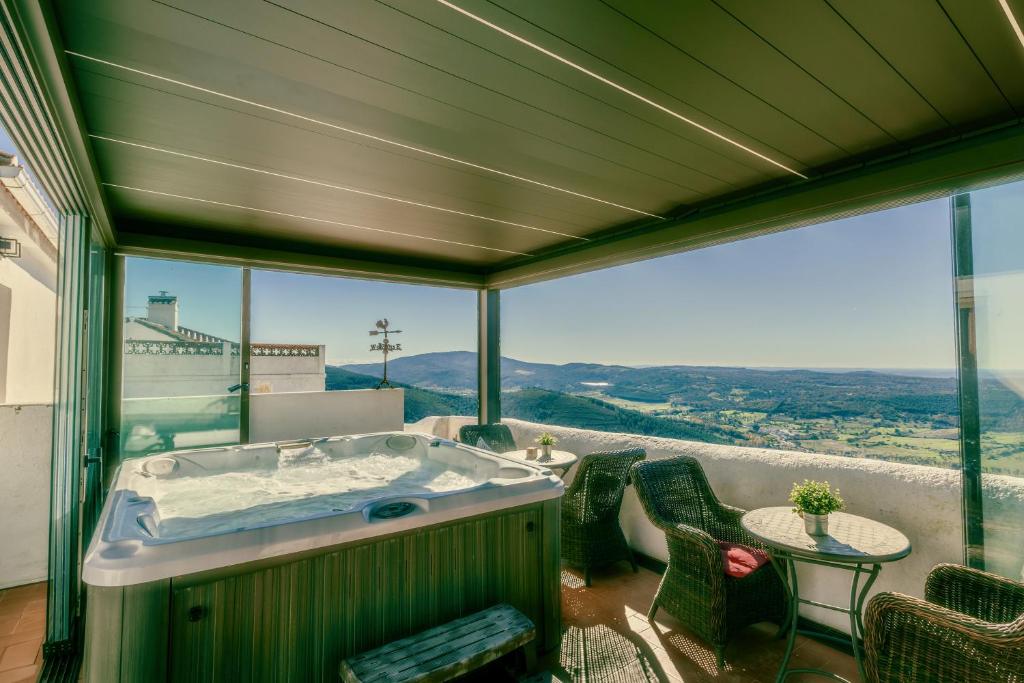
Marvão occupies a dramatic ridge of the Serra de São Mamede in Portugal's eastern Alentejo, not far from Spain. From below, its white houses and castle seem to cling to a narrow summit.
Portugal's tourism office explains why this was a strategic place: sheer slopes defend the north, south and west, while the easier approach is from the east, where the village expanded and its gates were reinforced.
The castle and medieval walls were important through successive conflicts, but the strongest reason to spend the night today is quieter: sunset over the hills, granite streets with little traffic and the view from the keep after walking through the village.
Inside the walls are Gothic arches, Manueline windows, wrought-iron balconies, whitewashed houses and the Church of Santa Maria, now the Municipal Museum. The Church of Santiago and the small Renaissance Chapel of Espírito Santo add stops to a short architectural circuit. Try to visit the castle when it is open rather than assuming the ramparts are accessible at every hour.
The centre is compact, but its pavement is uneven and steep, so the actual entrance to your hotel matters when you arrive with luggage. Marvão has more than one lodging rhythm. Around Largo de Santa Maria, the castle-side guesthouses suit views and early morning walks.
The lower eastern approach near Largo de Olivença makes road arrival easier while keeping the medieval streets within reach. Down below, Portagem sits by the Sever River and Roman bridge, with a calmer riverside setting, restaurants and possible summer river swimming.
Its name is linked to the historic toll station, including the movement of Jewish refugees fleeing the Iberian expulsions in the late fifteenth century; there is a memorial to that history by the crossing. Do not confuse Portagem with the hilltop village: going up to the castle is a separate, steep journey.
Beyond the village, the Roman city of Ammaia has archaeological remains, while the São Mamede landscape offers trails, birdwatching and rural drives. In November, the Chestnut Festival brings local food and visitors; the Al Mossassa festival in early October remembers the town's Islamic heritage.
Summer days can be hot and exposed on the walls, while autumn brings chestnuts and milder walks. One night in the walls lets you enjoy dawn and sunset. Two nights give enough time to add Portagem, Ammaia or a walk in the surrounding hills.
Common questions
Can I get around Marvão without a car?
The walled village is compact and walkable, though steep and cobbled. Portagem, Ammaia and trailheads beyond the walls generally need a vehicle or a carefully planned hike.
Is it better to stay inside the walls or by the river?
Inside the walls gives castle views, stone lanes and quiet early mornings. Portagem is a separate riverside base suited to road access, dining and warmer-season water activities.
What can I visit besides the castle?
The Municipal Museum in the former Church of Santa Maria, the Church of Santiago, the Chapel of Espírito Santo and the Roman city of Ammaia in the valley are useful additions.
When is the Chestnut Festival?
The village celebrates chestnuts in November, often drawing many visitors. The Al Mossassa festival of Islamic heritage is usually in early October. Verify the exact dates and access restrictions each year.
Why is Portagem historically significant?
The crossing over the Sever River is associated with a toll station and the movement of refugees, including Jews expelled from neighbouring Iberian kingdoms in 1492. A local memorial recalls this history.
How many nights should I stay?
One night works for castle walks at different times of day. Two allow a visit to Portagem, the Roman remains at Ammaia or the São Mamede countryside without rushing.
Prices are set by the booking site. We may earn a small fee, at no cost to you.